Contract vs Direct Hire: A Clear Comparison
Contract hire and direct hire are two common ways companies bring professionals into their organization. While both approaches aim to solve hiring needs, they differ significantly in flexibility, commitment, and risk. Understanding these differences helps companies choose the model that fits their goals.

Vladan Ćetojević

Summary
Choosing between contract hire and direct hire depends on how clearly a company understands its role requirements, timelines, and tolerance for change. The right model is less about contract structure and more about how much flexibility you need once work begins.
In practice, hiring decisions rarely fail because of the model itself. They fail when expectations are unclear or when the structure chosen does not match the level of certainty around the role.
Looking at contract hire and direct hire in practical terms makes it easier to choose an approach that supports progress without creating unnecessary constraints.

Need help with your hiring plans?
Book a short call to discuss your requirements and see how we support companies through different hiring approaches.
What Is Contract Hire
Contract hire refers to a hiring arrangement where a professional is engaged under a contractual agreement rather than as a permanent employee from the start. The scope, duration, and terms of the engagement are defined upfront, allowing companies to adjust the relationship as business needs evolve. A common example is engaging a senior developer to stabilize an existing codebase or support a time-bound delivery without expanding long-term headcount.
One industry research found that 36% of employed Americans identify as independent workers, including contract and freelance roles, highlighting how common flexible engagement models have become.
The term contract-to-hire is often used interchangeably with contract hire, typically to describe situations where a longer-term collaboration may be considered after an initial working period. In practice, both terms describe the use of a contract-based engagement before committing to permanent employment.

This model is commonly used when role requirements are still taking shape, timelines are uncertain, or companies want to reduce upfront risk while maintaining access to skilled professionals. This approach is often combined with remote hiring strategies, especially when companies prioritize speed and flexibility, such as when hiring in Eastern Europe.
What Is Direct Hire
Direct hire refers to a hiring arrangement where a professional is brought into a company as a permanent employee from the outset. The employment relationship is established immediately, with the individual joining the company’s payroll and operating under standard employment terms.
It is typically used when a company has clear, long-term needs for a role and is confident about the required skills, responsibilities, and expectations. This model emphasizes stability, continuity, and long-term ownership rather than short-term flexibility. This is typically the case for roles responsible for maintaining core systems or owning product development over multiple cycles.
Direct hire is most effective when role requirements are well defined, the position is critical to the business, and the company is ready to commit to a long-term employment relationship.
Contract Hire vs Direct Hire
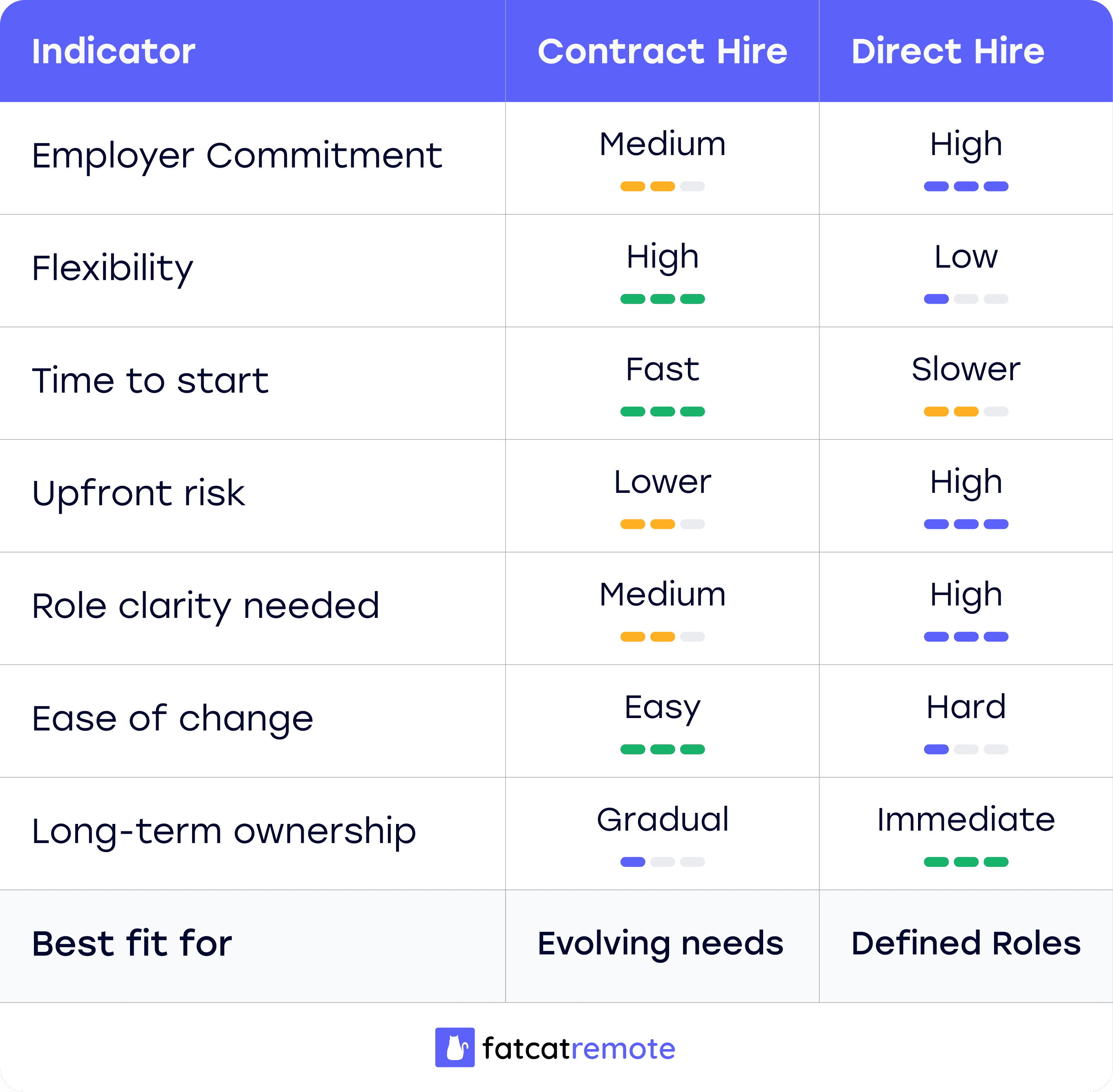
While both contract hire and direct hire are used to meet hiring needs, they differ in how companies manage commitment, cost, and risk.

Understanding these differences helps clarify which model fits a specific situation rather than treating one as a default choice.
Commitment and Flexibility
With contract hire, it’s easier to adjust as you go. The scope and duration are defined by agreement, which gives you options if priorities change or the role evolves. This can be useful when you’re still validating what the role should look like. If priorities change after a few months, contract hire is usually easier to adjust or conclude than a permanent role.
Direct hire places the commitment upfront. Stability and ownership are established from the start, but changing course later usually requires more effort.
Cost and Predictability
Cost behaves differently under each model. Contract hire keeps long-term commitments lower at the beginning, which can help when you want to stay lean or test assumptions before scaling. This difference becomes especially visible when budgets tighten, and fixed employment costs are harder to adjust.
Direct hire brings more certainty over time. Once salary and employment terms are set, ongoing costs are easier to forecast, which can be valuable when planning ahead.
Speed and Hiring Risk
Speed is another practical difference. Contract hire often allows work to start sooner, reducing delays when time matters. Delays during critical delivery phases can stall progress even when the final hiring decision is technically correct. It also limits early exposure if expectations are still being refined.
Direct hire usually takes longer because the decision carries more weight. The process is more deliberate, but mistakes can be harder to undo if the role or fit turns out to be misaligned.
How to Choose the Right Hiring Model
Choosing between contract and direct hire usually depends on how certain you are about the role and how much flexibility you need once work begins. There is no universal best option, only what fits your current situation.
If the scope of the role is still evolving or priorities may shift, contract hire allows you to stay adaptable while keeping progress moving. It works well when speed matters and long-term commitments feel premature.

Weighing the pros and cons of your hiring decision?
Talk to an expert and get clear guidance on how to move forward without committing to the wrong setup.
When the role is clearly defined and expected to remain core to the business, direct hire provides stability and long-term ownership. This approach makes sense when requirements are well understood, and the cost of change is low.
In practice, many companies move between these models over time. The key is choosing the one that aligns with your level of certainty today, not where you expect to be months or years down the line.
Hiring Model Decision Checklist
Answer each question with yes or no.
Is the role scope still evolving or likely to change?
Do priorities or requirements change frequently?
Do you need someone to start working quickly?
Is it unclear whether this role will remain long-term?
Would reversing a permanent hire be costly or disruptive?
Are you still validating whether this role makes sense in its current form?
Do you want flexibility to adjust responsibilities as work progresses?
Is long-term cost predictability difficult at this stage?
Are budgets or headcount plans likely to change in the near future?
If you answered yes to most questions, contract hire is the better fit.
If you answered no to most questions, direct hire is the better choice.
Why Execution Matters More Than the Hiring Model
Choosing between contract hire and direct hire sets the structure of the engagement, but it does not guarantee a good outcome on its own. In practice, many hiring issues come from how the role is executed after someone starts, not from the contract type itself.
Replacing an employee is often expensive, with estimates commonly ranging from 50-60% of annual salary once productivity loss and transition costs are factored in.

Even the most flexible hiring model can fail if expectations are unclear, onboarding is weak, or progress is not visible early on. A long-term hire can struggle if responsibilities are poorly defined or if feedback loops are missing during the first months of collaboration.
Unclear ownership in the first weeks is a common cause of delays across both contract and permanent roles. Many of these issues are process-related and can often be addressed by improving the hiring and recruitment process.
What matters most is how well the role is scoped, how clearly success is measured, and how quickly issues are identified and addressed. These factors influence results regardless of whether the person is engaged through a contract or hired permanently.
Focusing on execution helps reduce risk across both models and makes it easier to adjust when assumptions change. The hiring structure provides the framework, but execution determines whether the decision actually delivers value.
FatCat Remote and Flexible Hiring Models
In practice, hiring challenges rarely come from choosing the wrong model. They appear when expectations are unclear, vetting is inconsistent, or collaboration breaks down after someone starts. These issues affect outcomes regardless of whether the engagement begins as a contract or a permanent role.

FatCat Remote works across different hiring setups by focusing on consistency in how roles are defined, candidates are evaluated, and work is integrated into existing teams. This makes it easier to support both contract hire and direct hire.

Get hiring support that actually works in practice
Book a call to see how FatCat Remote helps companies execute hiring decisions without slowing down or locking into the wrong setup.
By keeping hiring flexible without sacrificing structure, companies can adapt their approach as needs evolve while maintaining consistency in quality and expectations. This allows hiring decisions to change over time without forcing a complete reset in how talent is sourced, evaluated, or managed.
Conclusion
Contract hire and direct hire are not competing strategies, but tools designed for different needs. Each can work well when applied in the right context and supported by clear expectations, realistic timelines, and strong execution.
Rather than treating one model as inherently better, the more reliable approach is to match the hiring structure to what you know today and stay flexible as circumstances change. Roles evolve, priorities shift, and hiring decisions often need to adapt along the way.
Ultimately, the outcome depends less on the contract type and more on how well the role is defined, how carefully candidates are evaluated, and how effectively work is integrated once collaboration begins. When those fundamentals are in place, both contract hire and direct hire can support sustainable growth.
Share this article: