Staff Augmentation vs Outsourcing: What’s the Difference?
Staff augmentation and outsourcing both help companies scale, but they solve very different problems. This guide explains how each model works in practice and how to choose the right approach for your case.

Vladan Ćetojević

Summary
Companies often compare staff augmentation and outsourcing when hiring slows down or delivery starts slipping. While both models provide external talent, they differ in control, flexibility, and how closely people integrate with your company. Understanding these differences early can prevent costly misalignment later.
When product timelines tighten and internal teams reach capacity, most companies look outside for help. The two most common options are staff augmentation and outsourcing. Although they’re often grouped together, they lead to very different working dynamics.
Staff augmentation embeds external developers directly into your existing workflow, while outsourcing hands out delivery to a third party. The right choice depends on how much control you need, how your product is evolving, and how closely external contributors must work with your team.

Curious how staff augmentation works in practice?
Take a look at the FatCat Remote staff augmentation process to see how companies typically go from sharing requirements to onboarding vetted remote talent.
What Is Staff Augmentation?
Staff augmentation is a hiring model where external professionals join your internal team to work under your direction. Instead of handing work to a third party, you extend your existing talent with additional capacity or expertise for as long as it’s needed.
Augmented team members use your tools, follow your processes, and contribute directly to your codebase or deliverables. You retain ownership over priorities, technical decisions, and outcomes, while avoiding the long-term commitment of permanent hiring.
When Staff Augmentation Makes Sense
The staff augmentation model works best when your product scope is still evolving and priorities change frequently. It’s a practical option if you need experienced contributors to start quickly, already have internal leadership guiding development, and want to maintain control over quality and direction.
It’s also useful when hiring full-time feels premature or disruptive, when budgets or headcount plans may shift, or when you want the flexibility to adjust responsibilities as work progresses without restructuring your core team.
What Is Outsourcing?
Outsourcing is a delivery model where you delegate a project or specific function to an external provider who takes responsibility for execution. Instead of integrating individual contributors into your company, you rely on a third party to manage resources, timelines, and deliverables.
In this setup, work is typically organized around scopes and milestones. Communication happens through project managers or account leads, and your involvement is focused on reviewing outcomes rather than directing day-to-day development. While this reduces internal operational load, it also limits visibility and control over how the work is carried out.
When Outsourcing Fits Better
Outsourcing is usually a better fit when requirements are clearly defined and unlikely to change. It can also make sense if you lack internal technical leadership and prefer a vendor to handle planning, delivery, and coordination.
This model works best for contained initiatives with predictable scope, where tight integration with your internal team is not essential and outcomes matter more than ongoing collaboration.

Industry research suggests the global outsourcing market is on track to exceed $696 billion in the 2030s, while market forecasts project the IT staff augmentation sector to grow even further, approaching $857 billion over the same period. Together, these figures reflect how companies increasingly rely on external talent, whether by delegating delivery entirely or embedding specialists directly into their existing operations.
Staff Augmentation vs Outsourcing: Key Differences
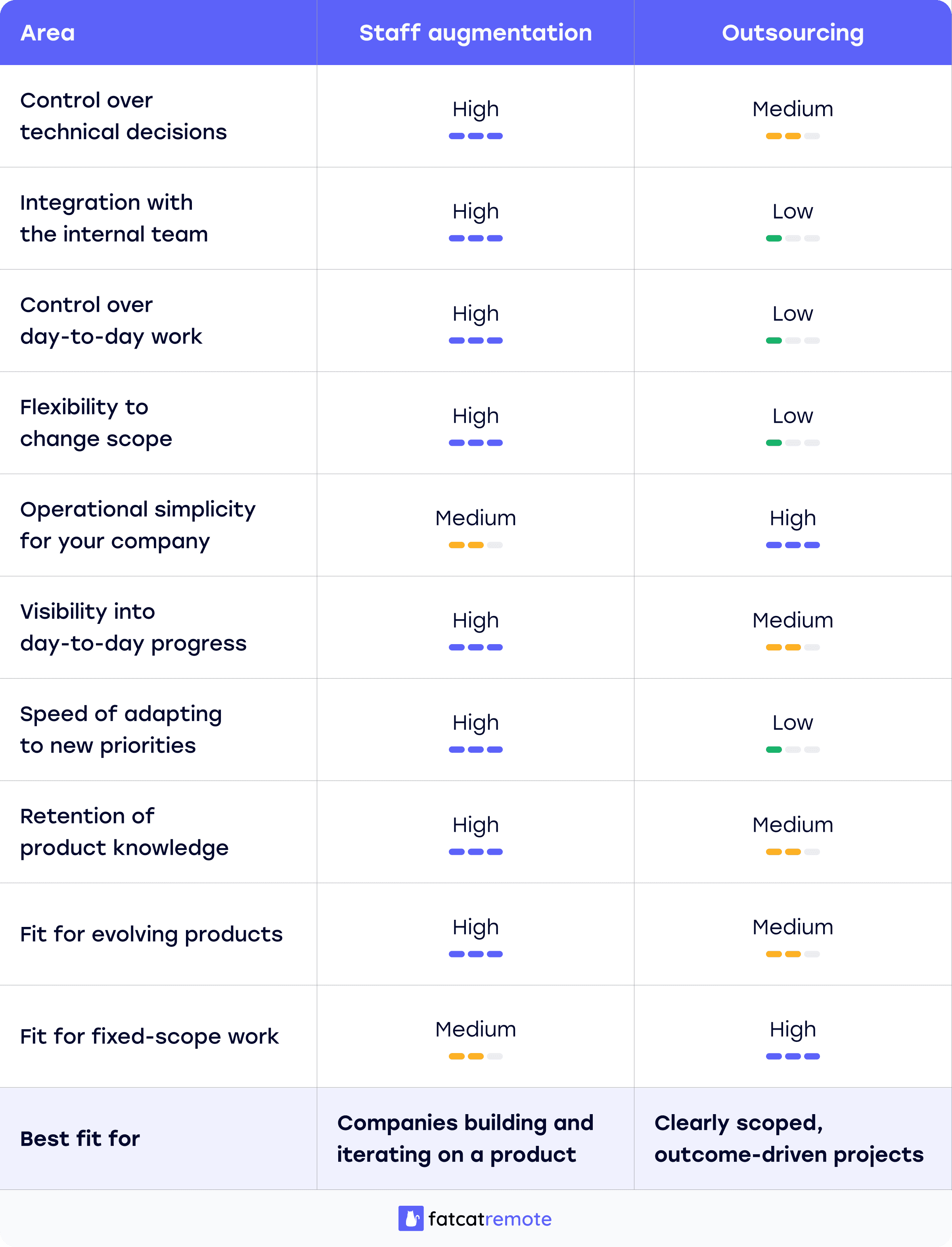
Once the basics are clear, the real difference between staff augmentation and outsourcing shows up in how work actually moves forward after onboarding.
Staff augmentation keeps decision-making inside your company. You stay directly involved in how work is executed and when priorities shift. Outsourcing spins much of that responsibility outward, relying on the vendor’s delivery model and internal coordination.
This distinction affects how companies adapt to change, how knowledge accumulates, and how closely execution stays aligned with product goals. The choice is less about staffing volume and more about how tightly external contributors need to operate within your organization.
Staff Augmentation or Outsourcing Checklist
Answer each question with yes or no.
Are delivery priorities expected to change after work has already started?
Do multiple internal stakeholders need to influence day-to-day decisions?
Will the work require frequent collaboration with your internal engineers or product managers?
Is the ongoing context about the product critical to making good technical decisions?
Do you expect the role or workload to evolve beyond its initial definition?
Would delays caused by realignment or contract changes be problematic?
Is maintaining internal visibility into progress important for planning?
Do you want the option to reduce or expand involvement without renegotiating scope?
Will decisions need to be made inside sprints rather than at milestone reviews?
Mostly yes → staff augmentation is usually the better fit
Mostly no → outsourcing may be more appropriate
How This Decision Impacts Product-Oriented Companies
This choice influences how product-oriented companies work in practice, not just how they scale:
Speed of iteration when requirements or priorities change
Clarity of ownership across product and engineering
Retention of product knowledge over time
Predictability of delivery as the scope evolves
Ability to maintain momentum during ongoing development
Over time, these factors shape team velocity, continuity, and alignment between planning and execution. For companies building an evolving product, the impact is ongoing. For fixed-scope initiatives, it is more limited and time-bound.

Still unsure?
Every company and product is different. Talking through your situation can help surface the right approach without committing to anything.
Common Mistakes Companies Make (With Examples)
Many companies struggle with this decision, not because the models are unclear, but because they apply the wrong one to the situation they’re actually in. The most common mistakes come from optimizing for short-term convenience instead of long-term execution.

Below are three real-world patterns that show where companies often go wrong.
Example 1: Building a Startup MVP
A startup begins building its MVP and outsources development to move quickly. At first, progress looks promising. But as user feedback comes in, features change, priorities shift, and the product direction evolves.
Each adjustment requires revisiting the scope, timelines, and deliverables. Communication flows through project managers instead of directly between product and engineering. Over time, iteration slows, and product context remains with the vendor instead of inside the startup.
In this case, staff augmentation would typically work better. Embedding developers directly into the core team allows faster iteration, shared ownership, and continuous alignment as the MVP takes shape.
Example 2: Outsourcing a Clearly Defined Internal Tool
A company needs a simple internal dashboard built for reporting. Requirements are fixed, and the tool has little impact on the core product. Instead of outsourcing the project, the company brings in augmented developers and manages everything internally.
The company spends time onboarding contributors, coordinating tasks, and reviewing work, even though the scope is unlikely to change. The added flexibility provides little value, while internal overhead increases.
Here, outsourcing would usually be the more efficient option. The work can be delivered externally, freeing the internal team to focus on higher-impact initiatives.
Example 3: Forcing One Model on Everything
A growing SaaS company tries to use a single engagement model for all work, from core product development to one-off projects. Over time, this creates friction: important product work feels constrained, while smaller initiatives require unnecessary internal coordination.
Eventually, the company adjusts. Staff augmentation is used for core product development, while contained projects, like a website redesign or data migration, are outsourced.
In many cases, combining both approaches intentionally leads to better outcomes than relying on a single model for every need.
How Modern Startups Use Staff Augmentation
Modern startups use staff augmentation to keep momentum high without locking themselves into rigid hiring decisions too early. Instead of waiting months for full-time hires or handing product development to an external vendor, they bring in experienced contributors who can start shipping quickly while founders stay close to product direction.
It’s commonly used to accelerate MVP development, extend engineering capacity during growth spikes, or fill specific skill gaps when timing matters. As the company evolves, augmented roles evolve with it, giving startups room to experiment, iterate, and scale without restructuring their organization every few months.

FatCat Remote supports this approach by connecting startups with vetted, remote-ready developers who integrate directly into existing workflows. This helps companies move faster, validate ideas in production, and build with confidence, while also reducing the operational overhead around recruiting, administration, payroll, and HR, without committing to long-term hires or outsourcing their core product.
Curious what this could look like for your company?
Talk through your situation and get clarity on whether staff augmentation makes sense for your current stage.
Conclusion
Choosing between staff augmentation and outsourcing is ultimately about how closely execution needs to stay connected to your business.
If you’re building or evolving a product, staff augmentation gives you flexibility without sacrificing ownership. If you’re delivering a clearly defined initiative, outsourcing can help you move work off your plate efficiently. Neither model is inherently better, but each fits a different stage, scope, and operating style.
The key is applying the right approach to the right type of work. Companies that do this well avoid unnecessary friction, preserve momentum, and scale with intention instead of reacting to short-term pressure. Make the decision based on how your company actually builds, not just on what looks faster or cheaper on paper.
Share this article: