How to Find Developers for Your Startup
Finding developers for a startup isn’t simple. Founders are pushed to hire quickly, make decisions with limited information, and commit to technical choices that are difficult to undo. This often happens before requirements are clear, processes are defined, or technical leadership is in place, increasing the risk of early hiring mistakes.

Vladan Ćetojević

Summary
Hiring developers at an early stage requires clarity more than speed. The most important decisions come before sourcing begins, including whether the startup needs execution capacity or technical leadership, and which hiring model fits the current stage. Different channels offer different trade-offs in time, risk, and effort, and choosing the wrong one can slow down progress rather than accelerate it. A focused evaluation process, clear role definition, and intentional pace help startups hire faster without creating long-term technical or organizational problems.
Early hires can accelerate product development and set a strong technical foundation, but the wrong choice can slow progress, increase costs, and create complexity that compounds over time.
The margin for error is small, especially in the early stages. Every hiring decision compounds over time, affecting product quality, development speed, and long-term technical stability.
Finding the right developers requires more than filling a role. It starts with defining what kind of developer your startup actually needs, knowing where to look, and evaluating candidates in a way that supports momentum without sacrificing quality.
-1.png&w=3840&q=75&dpl=dpl_ChbMTEvrWxbg99U1d2kVvsdHwLw5)
Hire developers without slowing your startup
When speed matters and hiring mistakes are costly, working with pre-vetted developers can help reduce risk and move faster with confidence.
Defining the Developer Profile Your Startup Needs
Before finding and recruiting software developers, it’s important to be clear about what role you expect them to play. This is where many startups run into trouble. Hiring often starts before expectations are fully defined, which makes it harder to evaluate candidates and easier to make the wrong call.

Some startups need a developer focused primarily on execution rather than technical leadership. This usually means building features, shipping an MVP, and turning product ideas into working software as efficiently as possible. If the product vision and direction are already clear, this type of role can help move things forward quickly.
Other startups need someone who can lead the technical side of the product. That includes making architectural decisions, selecting technologies, setting development standards, and thinking beyond immediate delivery. In these situations, the role looks less like a task-based developer and more like a technical partner.

If execution is the priority but the role is framed as technical leadership, progress can slow unnecessarily. If technical leadership is needed but the hire is focused only on delivery, early speed may come at the cost of stability later on. Recognizing which of these applies to your situation helps avoid both outcomes.
The startup stage also plays a role. MVP-stage companies tend to prioritize speed, flexibility, and scope control. As traction grows, maintainability, scalability, and team structure become harder to ignore. Being honest about where things stand now makes it easier to hire for current needs instead of future assumptions.
Flexibility is often part of the developer profile itself. Recent data shows that 64% of remote and hybrid workers would quit or start job hunting if remote work were removed. For startups, defining roles without flexibility in mind can narrow the talent pool and increase early replacement risk, especially during MVP development.
Startup Developer Profile Decision Checklist
Answer each question with yes or no.
If not sure about an answer, treat it as a no.
Is there a person in your startup responsible for technical decisions?
Do you already have the core technologies and tech stack defined for your product?
Is there an existing codebase that a person on your team understands and actively maintains?
Can you hand over requirements as clear, well-defined tasks without needing technical guidance?
Will this role focus mainly on building and shipping features?
Are you comfortable owning the technical direction as the product evolves?
Have the main technical risks and constraints already been identified?
Do you clearly know which specific technical skills you are missing?
Yes to most questions, you need a developer focused on execution.
No to most questions, you need someone who acts as a technical lead.
Choosing the Right Hiring Model for Your Startup
Once the developer profile is clear, the next decision is how that role should be filled. Different hiring models affect how quickly a startup can hire, how much effort the process requires, and how easily changes can be made later.
In-house developers: This model offers the highest level of ownership and long-term alignment. It works best when the product direction is stable, and the role is expected to grow with the company. The trade-off is commitment. In-house hiring takes time and requires ongoing investment, which can be challenging in early or fast-changing stages.
Freelancers: Freelancers are often hired when specific features or short-term deliverables need to be completed quickly, like building a landing page or integrating a payment provider. They can help move quickly during MVP development or early validation. The main limitations are continuity and accountability. As the product grows, knowledge transfer and availability can become constraints.
Remote full-time developers: This option sits between freelancers and in-house hires. Remote full-time developers provide consistency and deeper product involvement without the overhead of building a fully local team. For many startups, this model offers the best balance between speed and stability, especially when internal hiring resources are limited.
Early on, most startups are trying to ship, test, and adjust as quickly as possible. In those moments, flexibility and speed matter more than perfect structure. As the product stabilizes and the team grows, the focus shifts toward ownership, technical direction, and building something that can scale. Platforms like FatCat Remote are often used to bridge that gap and provide continuity as teams grow, helping startups move fast early with a reliable setup that supports long-term collaboration.

Choosing a hiring model doesn’t have to be guesswork
If you’re unsure whether you need an in-house hire, a freelancer, or a remote full-time developer, a short conversation can help clarify the right approach before committing.
Where to Find Developers for a Startup
Once the role and hiring model are clear, the next challenge is knowing where to actually look. Different channels vary in how fast candidates can be found, how much screening is required, and how predictable the outcome is.

FatCat Remote: Hiring through a vetted platform is often the fastest way for startups to access reliable developers without building an internal hiring process. Pre-screening reduces noise, shortens time-to-hire, and lowers the risk of mismatched expectations. This option works well when execution speed matters and hiring mistakes are costly.
Pros: pre-vetted developers, faster time-to-hire, lower hiring risk
Cons: less control over initial sourcingFounder’s close network: Former colleagues, trusted contacts, and past collaborators often provide high-trust hiring opportunities, especially in early stages.
Pros: strong alignment, faster trust-building, potential CTO-level hires
Cons: limited pool, risk of bias, not scalable long-termOnline communities: Developer communities, open-source projects, and startup ecosystems create indirect but meaningful hiring paths over time.
Pros: high-quality signal, strong technical engagement, long-term fit
Cons: slow relationship-building, unpredictable timelines, requires ongoing involvementLinkedIn: A common place for founders to search for developers directly. It offers access to a wide range of profiles, from individual contributors to technical leaders, but requires hands-on outreach and screening.
Pros: large talent pool, good for referrals, suitable for leadership roles
Cons: time-consuming, high noise, manual evaluation requiredJob boards: Job boards provide broad visibility for open roles and can attract high application volume, especially for well-defined positions.
Pros: wide reach, familiar to candidates, easy to post roles
Cons: low signal-to-noise ratio, slower hiring cycles, heavy screening effort
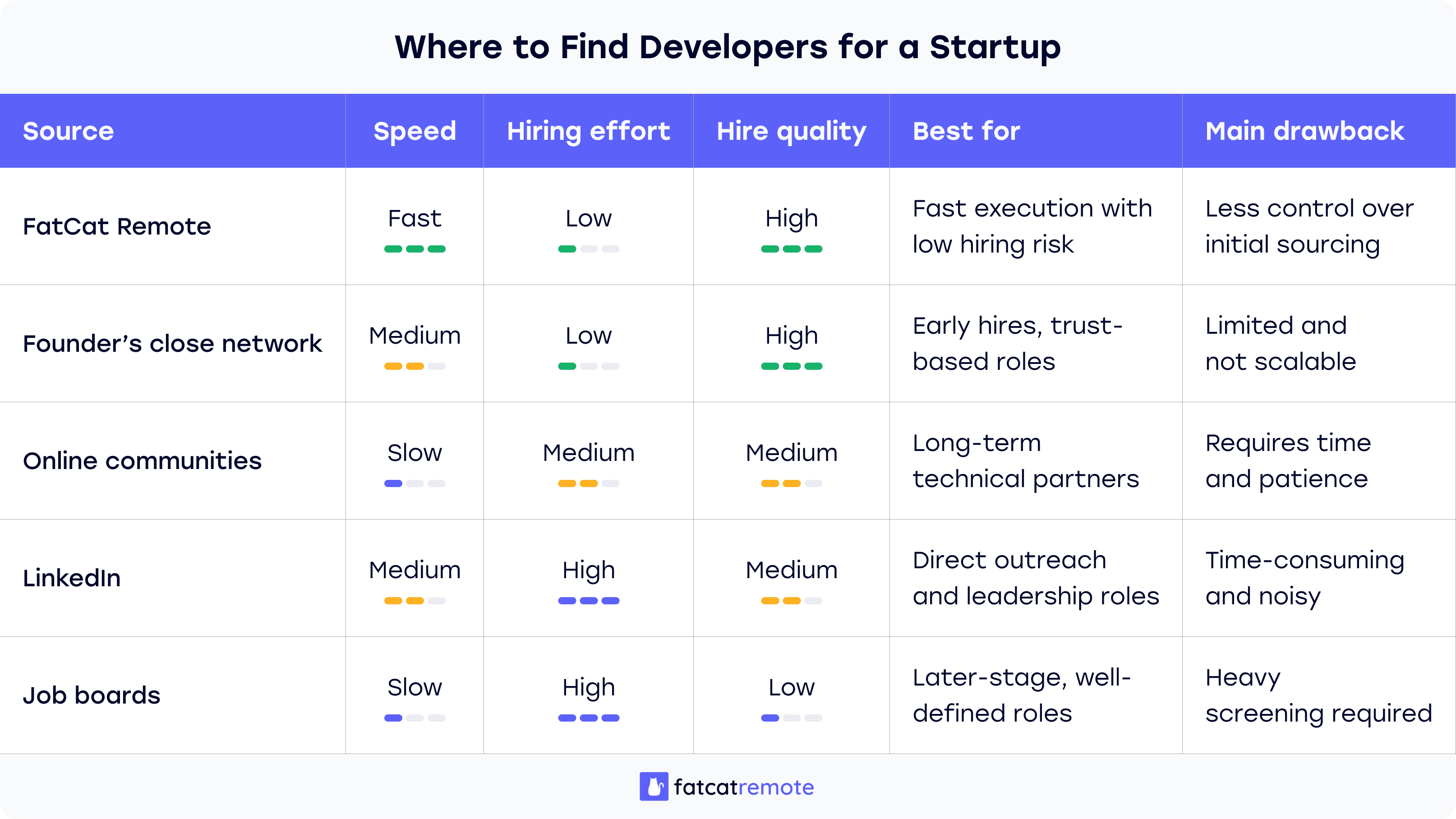
The choice of hiring channel affects not only how fast a startup can hire, but also how much effort and risk are involved at each stage. In practice, many startups combine multiple channels, but prioritizing the right one early can save time and reduce hiring mistakes.
Evaluating Developers Without Slowing Your Startup Down
Lengthy hiring processes often slow startups more than they help. Your goal is not to run a perfect evaluation, but to make a confident decision quickly. Portfolios and past work usually give you the strongest early signal. Instead of polished demos or big brand names, look for evidence of ownership, such as explaining why certain decisions were made or how trade-offs were handled.
Lengthy or poorly executed interview processes often slow startups more than they help. In fact, 49% of candidates in in-demand fields such as technology say they’ve turned down a job offer because of a bad hiring experience, underscoring how process quality matters as much as evaluation accuracy.
Interviews should stay focused and efficient. A short conversation about how a developer approaches decisions, handles ambiguity, and explains trade-offs often reveals more than deep technical grilling. At this stage, clarity of thinking and communication tend to matter as much as technical depth.

Technical assessment tasks work best when they are small, time-boxed, and closely related to the work the developer would actually do, so they reflect real collaboration rather than testing endurance. When they become overly complex, they tend to add friction without improving outcomes. Live coding can help in some cases, but it is often less representative than discussing previous projects and decisions.
In some cases, developers are cautious about interview processes that resemble unpaid work or blur boundaries, especially if they have previously worked under restrictive agreements such as an NDA. Clear tasks and interview discussions focused on past work reduce this friction while still providing a strong evaluation signal.
Hiring Developers Faster Without Breaking the Process
When startups try to hire faster, mistakes usually come from cutting the wrong corners. The issue is rarely the speed itself, but the lack of structure behind it.

Some mistakes show up again and again:
Hiring too early, before requirements or priorities are clear enough to define concrete tasks
Hiring too cheaply, which often leads to rework, delays, or replacement hires
Skipping validation because there isn’t time for proper screening
Confusing speed with urgency, rushing hiring decisions that are expensive and hard to reverse
These problems tend to compound. A rushed hire with unclear expectations can slow development, increase costs, and create friction that affects everything from product quality to team morale.
Hiring faster works best when friction is removed from the process, not from decision-making, which keeps speed from turning into rework later. Clear role definitions, fewer but more focused interviews, and early screening all help reduce risk without adding delay.

Avoid common hiring mistakes
If you want to move fast without skipping validation or making rushed decisions, working with pre-vetted developers can help reduce noise and hiring risk early on.
Conclusion
Finding developers for a startup is not just a hiring task. It’s a series of decisions that affect product speed, technical direction, and long-term momentum. The biggest risks usually come from unclear roles, rushed processes, and choosing channels that don’t match the startup’s stage.
Being deliberate about what kind of developer you need, how you evaluate candidates, and how fast you move reduces rework, failed hires, and unnecessary delays. When the process is intentional, speed becomes an advantage instead of a liability.
The earlier these decisions are made with clarity, the fewer problems need fixing later.
Share this article: